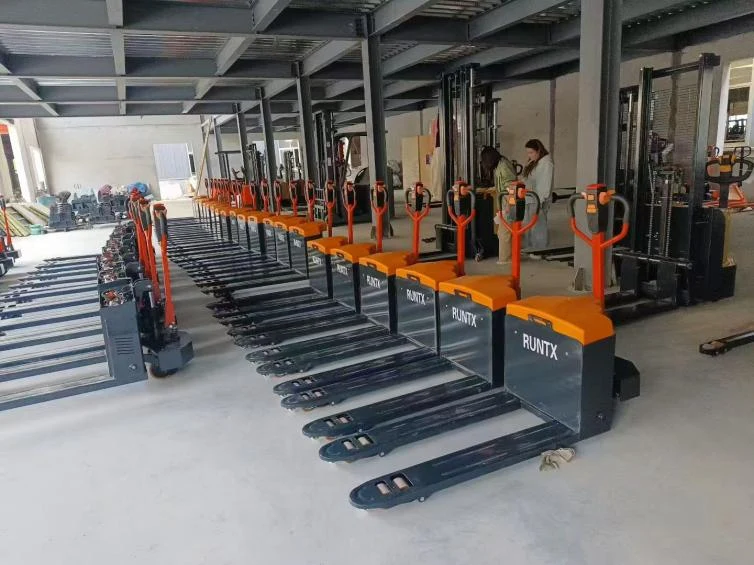
An electric pallet truck moves palletised goods horizontally between receiving, staging, workstations and dispatch. Compared with a manual pallet jack, its value is most apparent in repeated moves and longer transport routes. The right choice depends on the pallet, load, route and shift pattern.
1. Battery-powered indoor transport
There is no combustion-engine exhaust at the point of use, which supports indoor material flow. The site still needs the appropriate charging arrangements, ventilation and battery care. Cold, wet or specialist environments require a suitably configured model; electric power alone does not establish suitability.
2. Less manual pushing and lifting effort
A fully electric truck powers travel and lifting, reducing repeated pulling, pushing and pumping. Semi-electric models provide different combinations, so check the actual functions. An integrated control handle puts common tasks within reach, while training and appropriate speed remain essential around loads, corners and pedestrians.
3. Compact handling between work areas
The right chassis dimensions, turning space and fork size help organise short-distance transfers. Pedestrian and ride-on models suit different travel distances and work patterns. Measure aisles, doorways, gradients and loading areas, and check floor and pallet compatibility before choosing equipment.
4. Planned maintenance and charging
An electric pallet truck has no combustion engine to service, but wheels, brakes, hydraulics, electrical connections and the battery still need attention. Battery life varies with duty, charging practice, temperature and care; one fixed cycle count or operating-hour claim cannot describe every installation. Planned checks, charging time and responsive service help sustain useful availability.
Start with the application details
- Confirm typical and maximum load weights, pallet dimensions and the underside layout.
- Describe travel distance, daily moves, shifts and available charging windows.
- Check aisle width, floors, gradients and environment. Choose a suitable stacker or lift truck when high-level stacking is needed.
SOLAITE can discuss the configuration against the actual workflow, helping match the truck to the site’s handling rhythm.